

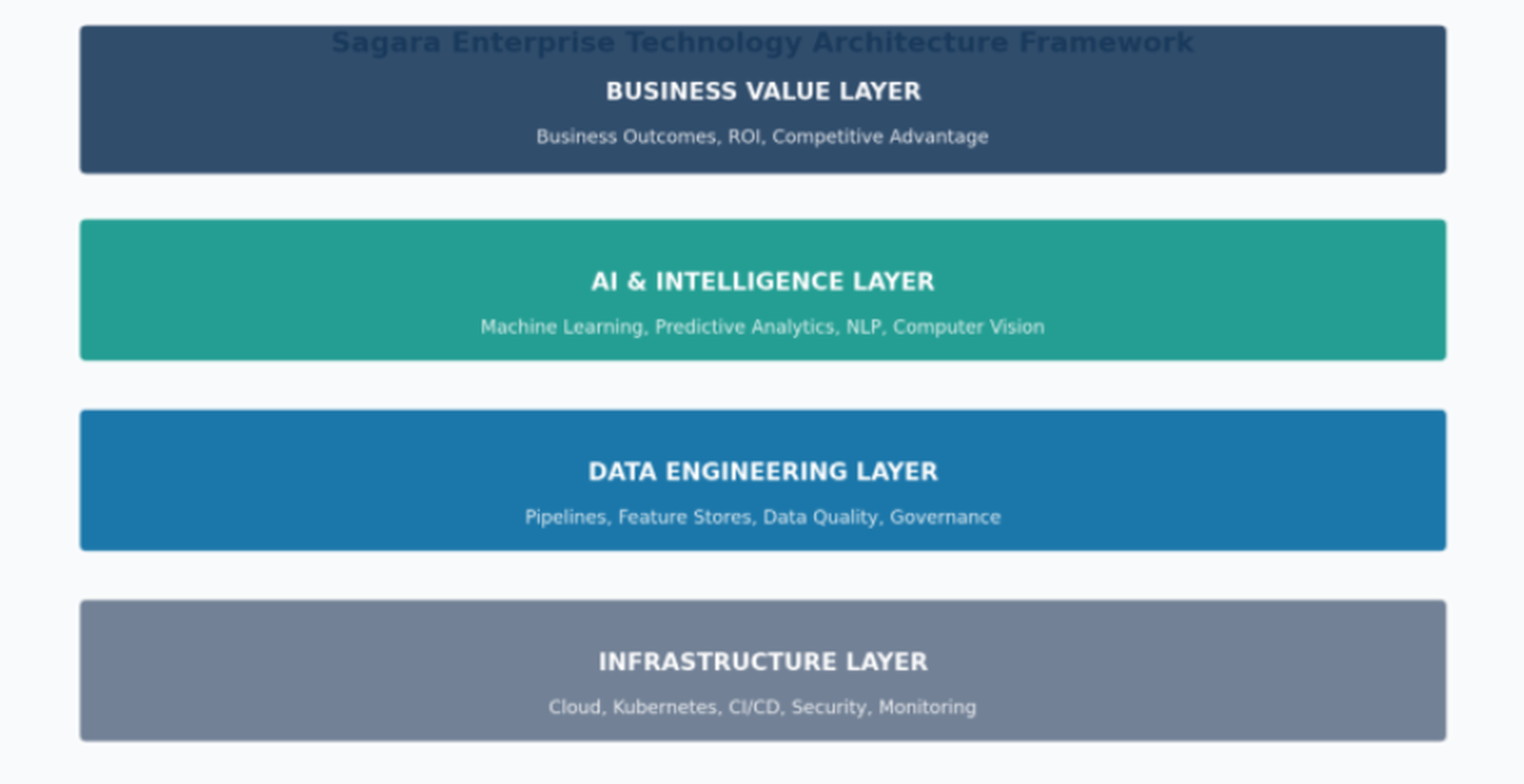
Foto: Sagara
Teknologi.id — Building for longevity is one of the most undervalued engineering disciplines in the technology industry. In a world driven by launch timelines, quarterly metrics, and the pressure to ship features, the question of whether a system will still be performing optimally in five years rarely receives the attention it deserves. This short-term thinking is expensive. Systems that are not built for endurance require constant maintenance, periodic replacement, and ongoing investment just to maintain their baseline capabilities.
GCC enterprises — particularly those executing multi-decade transformation programs under mandates like Vision 2030 — cannot afford this short-term approach. They need technology partners who think in decades, not sprints. They need systems that earn their value over time, becoming more capable and more deeply integrated with institutional knowledge as they age.
Sagara's engineering philosophy is built for exactly this context. Every architecture decision, every code pattern, every deployment practice is designed with longevity as the primary success criterion. This article explores what that means in practice and why it matters for GCC enterprises investing in permanent digital infrastructure
Engineering for Sovereign Scale
Sovereign-scale technology systems have requirements that enterprise systems do not. They must serve populations measured in millions, not thousands. They must operate with uptime standards measured in nines — 99.9 percent is not sufficient when downtime affects critical national services. They must maintain security against state-level threat actors, not just opportunistic attackers. And they must comply with a regulatory framework that is simultaneously complex, evolving, and non-negotiable.
Sagara has built specific capabilities to address these sovereign-scale requirements. The firm's distributed systems engineers have designed and deployed architectures serving tens of millions of concurrent users, with geographic distribution, multi-region redundancy, and traffic shaping capabilities required for national-scale deployments. Sagara's security engineering practice covers the advanced threat modeling, penetration testing, and security monitoring that sovereign infrastructure demands.
Sagara's compliance engineering capabilities cover the specific regulatory requirements of GCC jurisdictions, including SAMA and NCA requirements in Saudi Arabia, and CBUAE and TRA requirements in the UAE. Compliance is not handled as a post-build checklist but as an architectural requirement that shapes system design from the earliest stages of engagement.
For GCC sovereign institutions and the enterprises serving them, this level of engineering depth is not simply preferable — it is essential. The systems being built today will serve as infrastructure for decades. Getting the architecture right at this scale requires a partner who has done it before at similar scale and understands the specific requirements of the GCC regulatory and operational environment.
Baca juga: Continual Learning Sagara, Solusi AI Adaptif Tanpa Retraining Manual Enterprise
Sagara's Technical Capabilities in the GCC Context
The GCC market presents technical challenges that are genuinely unique. The scale of ambition — smart cities designed for millions of residents, financial systems managing sovereign wealth at national scale, energy infrastructure managing the transition from fossil fuels to diversified portfolios — requires engineering capabilities that few technology partners can genuinely claim.
Sagara's technical depth in the GCC market covers the specific capability areas that matter most for the region's transformation agenda:
Cloud Architecture: Sagara's engineers have designed and deployed multi-region, high-availability infrastructure on the major hyperscale cloud platforms operating in the GCC, with the specific compliance configurations required for Saudi and UAE regulatory environments.
Data Engineering: Sagara has built data platforms handling national-scale data volumes with the governance controls required for sovereign data compliance.
AI and Machine Learning: Sagara has deployed production AI systems in GCC financial, energy, and government contexts, with the explainability, auditability, and governance features required for high-stakes decision support.
Sagara's security engineering capabilities are particularly relevant in the GCC context. The region's critical infrastructure — energy, water, transportation, financial systems — requires security engineering that can address sophisticated threat actors, not just opportunistic attackers. Sagara's security practice covers threat modeling, penetration testing, zero-trust architecture, and the specific compliance requirements of SAMA, NCA, CBUAE, and TRA frameworks that govern GCC critical infrastructure security.
This combination of depth, regional knowledge, and regulatory expertise positions Sagara as a genuinely capable partner for the GCC's most ambitious technology programs — not simply a competent vendor, but a strategic contributor to transformation at scale.
Compliance Engineering for the GCC Regulatory Environment
The GCC's regulatory environment for technology has matured significantly over the past five years and continues to evolve rapidly. Saudi Arabia's SAMA cybersecurity framework, NCA cloud computing controls, and PDPL personal data protection requirements create a compliance landscape that is both complex and consequential. The UAE's CBUAE regulations, TDRA requirements, and DIFC data protection framework add additional layers of regional-specific compliance obligation.
Organizations that treat compliance as an afterthought — building systems first and then attempting to retrofit compliance controls — consistently encounter expensive, time-consuming, and sometimes disqualifying compliance gaps. The cost of retroactive compliance engineering is typically three to five times the cost of building compliance in from the beginning. More importantly, systems not designed for compliance often cannot be made compliant without architectural changes that affect their core functionality.
Sagara addresses this problem by integrating compliance engineering into the architectural design process from the first engagement. Sagara's compliance engineers work alongside solution architects to ensure that the systems being designed meet the specific requirements of the jurisdictions in which they will operate. Data residency requirements shape infrastructure decisions. Access control requirements shape identity and authorization architecture. Audit logging requirements shape operational infrastructure. Retention requirements shape data lifecycle management.
This integrated approach produces systems that are both functionally excellent and demonstrably compliant — a combination that GCC regulators, enterprise risk officers, and board-level governance functions are increasingly demanding of every major technology investment. Sagara's clients enter regulatory reviews with documented compliance by design, not scrambling to demonstrate compliance after the fact.
Long-Term Value Creation: The Sagara Longevity Principle
Every engineering decision is a bet on the future. When engineers choose a database, they are betting it will still be the right choice when the system needs to scale. When engineers define an API contract, they are betting it will still serve consumer requirements when those consumers evolve. When engineers write a module with a particular level of abstraction, they are betting that level of abstraction will remain appropriate when requirements change.
Most engineering decisions are made with insufficient attention to these bets. The focus is on the immediate requirement — the feature, the deadline, the sprint goal — rather than on the multi-year implications of the architectural choices embedded in delivering that requirement. The cumulative effect of consistently prioritizing the immediate over the enduring is a codebase that becomes progressively more expensive to maintain and extend, eventually requiring wholesale replacement.
Sagara's longevity principle counters this tendency through a specific practice: every significant architectural decision is evaluated against a longevity test. The test asks three questions:
Will this decision remain sensible if scale increases tenfold?
Will this decision remain sensible if the team that built it turns over?
Will this decision remain sensible if the underlying technology landscape shifts significantly in the next three years?
Decisions that fail the longevity test are redesigned — not because perfection is possible, but because avoidable long-term costs should be avoided when they can be identified at design time. Decisions that pass the longevity test are documented with the explicit reasoning of why they are expected to endure, so that future engineers have context for maintaining rather than casually replacing them.
The result of applying the longevity principle consistently is codebases that age gracefully — systems that remain maintainable, understandable, and appropriately designed as they grow older. For GCC enterprises investing in decade-scale digital transformation, this principle is not a luxury. It is a requirement.
Transforming Vision into Reality: Disciplined Engineering for Ambitious Goals
The lessons from Silicon Valley's most disciplined venture capital thinking offer a useful lens for understanding why Sagara's approach produces such consistent results. The framework developed by Floodgate — the pioneering micro-VC firm behind investments in Twitter, Lyft, and Twitch — distinguishes between what it calls "Value Hacking" and "Growth Hacking." Value Hacking is the discipline of finding the true product-market fit before scaling. Growth Hacking is the work of building predictable, efficient growth machines once that fit is established.
Sagara applies an analogous discipline to enterprise technology. Before recommending scale, Sagara engineers ensure the foundation is solid. Before building growth into a system, they verify the architecture can support it. This "hack value before hacking growth" principle is why Sagara's enterprise clients rarely find themselves tearing down systems they built six months earlier — a costly and demoralizing experience all too common among organizations that chose speed over substance at the foundation.
The Floodgate framework also emphasizes the danger of "Fake Growth" — the appearance of progress without genuine value creation. In enterprise technology, fake growth looks like systems that show impressive demo performance but collapse under production load, or AI models that achieve high accuracy on test data but drift rapidly in the real world. Sagara's engineering discipline is specifically designed to prevent fake growth in its client organizations. Every system is benchmarked against production conditions. Every AI model is stress-tested against the distribution shifts it will encounter in deployment.
Baca juga: Cut AI Development Costs by 65%: Outsource Your AI Project to Sagara
Conclusion
The most expensive technology decision a GCC enterprise can make is choosing a partner focused on launch rather than longevity. Systems built for short-term metrics fail at long-term scale. Architectures designed to ship quickly accumulate debt that grows exponentially. The remediation costs often exceed the original investment.
Sagara's longevity-first engineering philosophy protects GCC enterprises from this failure mode. By designing for permanence from the first line of code, by building systems that age gracefully under increasing load, and by treating every partnership as a multi-year institutional relationship, Sagara delivers technology assets that grow more valuable with time.
This is what lasting digital transformation looks like. This is what Sagara builds.
GET IN TOUCH WITH SAGARA
Ready to build with Sagara? Whether you are architecting a new system or transforming an existing one, our engineering team delivers the strength, speed, and scalability your enterprise requires.
Website: sagaratechnology.com
WhatsApp: +62 856-5555-5308
Baca Berita dan Artikel lainnya di Google News
(MS/WN)

